Aurora Theatre’s production of “Hysteria” intrigues and mesmerizes
By Stephanie Wright Hession
Arts and Culture Writer
What happens when a highly imaginative playwright places Sigmund Freud, Salvador Dali and a deeply distressed female stranger together on a rainy London night? “Hysteria,” an engaging and disturbing tale by British playwright Terry Johnson. Berkeley’s Aurora Theatre’s 16th season opener, directed by Joy Carlin, "Hysteria" initially feels like a typical British farce but soon morphs into something much darker and more complex.
Set in 1938 England, the tale begins one late evening in Freud’s (Warren David Keith), Hampstead study, which set designer Richard C. Ortenblad Jr. creates with French glass doors looking out on to a garden, a trio of glowing, dangling etched lights and a plain white wall adorned with a clock and a work by Pablo Picasso. On stage a wooden desk, covered with international antiquities such as an obelisk and a goddess, sits near a plum-hued velvet chair, a chaise covered with Persian rugs and a petite table topped with a chess set, making it all believable as Freud’s office.
Freud, who fled Vienna to escape the wrath of the Nazis, is now dying of inoperable jaw cancer and coping with the increasingly difficult levels of pain with shots of morphine administered by his doctor, Abraham Yahuda (Charles Dean). Despite the grim circumstance, the witty quips between Freud and Yahuda emit generous amounts of laughter from the audience. But the feel of the play quickly changes with the rumble of thunder and the unexpected appearance of Jessica (Nancy Carlin), a young woman who frantically wraps at Freud’s front door.
At first she claims to be a woman suffering from anorexia and a psychosomatic disorder of having three of her fingers stuck together. Freud, old and ailing, possesses no interest in helping her and tries to get rid of her with a referral to another psychiatrist. But the woman will have none of it and soon Freud realizes that she’s imitating a hysteria case study he published thirty years before. Jessica then fesses up to being a student whose thesis revolves around this particular case, saying she’s seeking further insight from Freud. However, she still isn't being truthful and in fact holds dark secrets which she reveals to Freud.
Just when the circumstances become heavier and more unsettling, Surrealist artist Salvador Dali (Howard Swain) arrives for a scheduled visit with Freud, elevating the mood and amping the pace to madcap levels. It’s fascinating to observe how Dali reacts to Freud and Jessica’s interactions and revelations—some touching and others dealing with horrific events of the past. The intensity of one particular scene feels that much more eerie, thanks to the special effects of melting clocks and walls.
An impeccable cast makes this an engrossing production. Warren David Keith portrays Freud with brilliant perfection, Howard Swain gives a hilariously exaggerated portrayal of Dali, Nancy Carlin gives a chilling performance as Jessica and Charles Dean plays Dr. Yahuda wonderfully.
“Hysteria,” plays Wednesdays through Sundays through Sept. 30 at the Aurora Theatre, 2081 Addison Street, Berkeley. Tickets range from $40 to $42. For tickets call (510) 843-4822 or visit www.auroratheatre.org.
Friday, August 31, 2007
Monday, August 20, 2007
Powerful vocals, delightful dancing and a melancholy ambiance makes “Blues in the Night” an engrossing production”
By Stephanie Wright Hession
Arts and Culture Writer
Rejection by their men, the longing for dreams unfulfilled and the sweet memories of good times past-and the residual loneliness of it all-give the three women in “Blues in the Night” reason to convey their yearnings through a series of melancholy tunes in this emotionally rich musical. Conceived and directed by Sheldon Epps, with musical direction by Rahn Coleman and choreography by Kenneth Lee Roberson, the production opened last Wednesday at the Post Street Theatre in San Francisco.
Cast members Freda Payne, Carol Woods, Paulette Ivory and Maurice Hines soulfully bring to life blues classics by Bessie Smith, Duke Ellington, Benny Goodman, Johnny Mercer and more, that people have sung for decades. However, the songs endure thanks to their poignant themes and remain fresh, thanks to the brilliant vocal skills of Payne, Woods and Ivory, as well as the charismatic performance of singer and hoofer Hines, who plays the hotel’s saloon singer and the production’s narrator.

It all take place in a shoddy Chicago hotel in the late 1930s, on scenery and lighting designer Douglas D. Smith’s morose set with its slanted, off kilter windows, a hotel sign illuminated with dotted white lights against a city skyline awash in plum, lavender and gray hues with a deep midnight blue sky. On stage he furnishes the women’s three rooms with vanity tables topped with perfume bottles, a large traveling trunk adorned with destination stickers and bedding made with ruby and gold fabrics.
Each of the women living there represents different phases in life. Paulette Ivory as the young, optimistic The Girl with a Date, embodies hope and new beginnings. The mature, wiser The Woman of the World illustrates the savvy gained from life experience. And The Lady from the Road, the maternal figure who comforts the other two women, lives in the safety and shelter of a world she's created with memento filled scrapbooks of her singing days and her former lovers. She also keeps her past alive by wearing outlandish costumes she once donned on stage, now stowed in her traveling trunk.
Each number in “Blues in the Night” serves as a vignette to reveal another aspect to one of the characters, whether it's dealing with a current disappointment or an emotional scar caused by hurts of long ago. Some songs are deeply moving while others are light and a bit naughty.
“Blues in the Night” begins full force and gets the audience members' feet tapping with a wonderful company rendition of “Blue Blues.” The energy continues when Woods sings “New Orleans Hop Scop Blues,” especially humorous because she wears an orange, fringy, flapper dress with a funky, matching hat. Alternatively, she enthralls the audience with her heart wrenching performance of “Wasted Life Blues.” Woods possesses that marvelous mix of a gorgeous voice and comedic talent. Her performance of “Lover Man” also proves outstanding.
The elegant Payne demonstrates her beautiful voice in “Stompin’ at the Savoy,” complete with a sensual dance under a shimmery disco ball spinning from the ceiling. And she scats during this number too, much to the thrill of theatergoers. Her voice is also deeply stirring when she sings “Lush Life.”
Ivory superbly conveys the anguish her character is experiencing with her haunting performance of “Willow Weep for Me.”
Hines is utterly charming as he sings and dances his way through “I’m Just a Lucky So-and-So” and it’s exciting to watch him tap across the stage, displaying his amazing talent.
“It Makes My Love Come Down” demonstrates the beautiful harmony between Payne, Woods and Ivory, when the three women give a potent performance of this sassy and juicy number. Ivory and Payne also sing a moving duet of “When Your Lover Has Gone.”
Overall, “Blues in the Night” offers a delightful opportunity to enjoy a superb evening of the blues performed by exquisite performers and should not be missed.
“Blues in the Night” plays Tuesdays through Sundays, through October 28 at the Post Street Theatre, 450 Post Street, San Francisco. Tickets range from $40 to $75. For tickets call (415) 771-6900 or visit www.ticketmaster.com. For more information go to www.bluesinthenightsf.com or visit www.poststreettheatre.com.
Arts and Culture Writer
Rejection by their men, the longing for dreams unfulfilled and the sweet memories of good times past-and the residual loneliness of it all-give the three women in “Blues in the Night” reason to convey their yearnings through a series of melancholy tunes in this emotionally rich musical. Conceived and directed by Sheldon Epps, with musical direction by Rahn Coleman and choreography by Kenneth Lee Roberson, the production opened last Wednesday at the Post Street Theatre in San Francisco.
Cast members Freda Payne, Carol Woods, Paulette Ivory and Maurice Hines soulfully bring to life blues classics by Bessie Smith, Duke Ellington, Benny Goodman, Johnny Mercer and more, that people have sung for decades. However, the songs endure thanks to their poignant themes and remain fresh, thanks to the brilliant vocal skills of Payne, Woods and Ivory, as well as the charismatic performance of singer and hoofer Hines, who plays the hotel’s saloon singer and the production’s narrator.

It all take place in a shoddy Chicago hotel in the late 1930s, on scenery and lighting designer Douglas D. Smith’s morose set with its slanted, off kilter windows, a hotel sign illuminated with dotted white lights against a city skyline awash in plum, lavender and gray hues with a deep midnight blue sky. On stage he furnishes the women’s three rooms with vanity tables topped with perfume bottles, a large traveling trunk adorned with destination stickers and bedding made with ruby and gold fabrics.
Each of the women living there represents different phases in life. Paulette Ivory as the young, optimistic The Girl with a Date, embodies hope and new beginnings. The mature, wiser The Woman of the World illustrates the savvy gained from life experience. And The Lady from the Road, the maternal figure who comforts the other two women, lives in the safety and shelter of a world she's created with memento filled scrapbooks of her singing days and her former lovers. She also keeps her past alive by wearing outlandish costumes she once donned on stage, now stowed in her traveling trunk.
Each number in “Blues in the Night” serves as a vignette to reveal another aspect to one of the characters, whether it's dealing with a current disappointment or an emotional scar caused by hurts of long ago. Some songs are deeply moving while others are light and a bit naughty.
“Blues in the Night” begins full force and gets the audience members' feet tapping with a wonderful company rendition of “Blue Blues.” The energy continues when Woods sings “New Orleans Hop Scop Blues,” especially humorous because she wears an orange, fringy, flapper dress with a funky, matching hat. Alternatively, she enthralls the audience with her heart wrenching performance of “Wasted Life Blues.” Woods possesses that marvelous mix of a gorgeous voice and comedic talent. Her performance of “Lover Man” also proves outstanding.
The elegant Payne demonstrates her beautiful voice in “Stompin’ at the Savoy,” complete with a sensual dance under a shimmery disco ball spinning from the ceiling. And she scats during this number too, much to the thrill of theatergoers. Her voice is also deeply stirring when she sings “Lush Life.”
Ivory superbly conveys the anguish her character is experiencing with her haunting performance of “Willow Weep for Me.”
Hines is utterly charming as he sings and dances his way through “I’m Just a Lucky So-and-So” and it’s exciting to watch him tap across the stage, displaying his amazing talent.
“It Makes My Love Come Down” demonstrates the beautiful harmony between Payne, Woods and Ivory, when the three women give a potent performance of this sassy and juicy number. Ivory and Payne also sing a moving duet of “When Your Lover Has Gone.”
Overall, “Blues in the Night” offers a delightful opportunity to enjoy a superb evening of the blues performed by exquisite performers and should not be missed.
“Blues in the Night” plays Tuesdays through Sundays, through October 28 at the Post Street Theatre, 450 Post Street, San Francisco. Tickets range from $40 to $75. For tickets call (415) 771-6900 or visit www.ticketmaster.com. For more information go to www.bluesinthenightsf.com or visit www.poststreettheatre.com.
Tuesday, August 1, 2006
Lamplighters create magic with its production of Gilbert and Sullivan's "The Witch's Curse: Ruddygore"
By Stephanie Wright Hession
Arts and Culture Writer
Magnificent voices, delightful music, Victorian humor and exquisite costumes highlight Lamplighters Music Theatre's production of Gilbert and Sullivan's "The Witches Curse: Ruddygore," a comic opera and thriller directed by Jane Erwin Hammett and conducted by musical director Baker Peeples, with book and lyrics by Sir William S. Gilbert and music by Sir Arthur Sullivan.
Set in the early 19th century in the seaside village of Rederring on England's Cornish coast, the tale centers on Rose Maybud (Elena Sophia Krell), a naive and proper maiden and her timorous admirer, gentleman farmer Robin Oakapple (F. Lawrence Ewing). It all takes place on scenic designer Peter Crompton's set with its trio of massive, lovely vintage style postcards featuring a lighthouse, a tall ship, a castle, roses, cliffs and the seashore along with the slogan "Greetings from Scenic Rederring 'Wedding Capitol of Lower Cornwall.'"
But the audience learns there's a much darker aspect to the saga during the number "Sir Rupert Murgatroyd," sung splendidly by Katy Daniel as Rose's guardian Dame Hannah, accompanied by the female chorus.
An endearing scene between Rose and Robin occurs after the two shyly encounter one another on a village street and awkwardly attempt to express the affection they feel toward each other during their sweet duet "I Know a Youth."
Things get complicated with the arrival of sailor Richard Dauntless (John Brown), who comes to town after years at sea. He quickly charms the professional bridesmaids-needed with so many couples coming to Rederring to be married-with the appealing number "From the Briny Sea." He also engages the bridesmaids in a mirthful dance and soon has them pulling from either end of a large rope in an impromptu game of tug of war.
Robin turns to the boisterous Richard to represent him in his bid for Rose's hand in marriage, never expecting that he would also fall in love with her. Richard overtly declares his affection for Rose with several kisses during the humorous and flirtatious number "The Battle's Roar is over." Now, Rose must decide between the introverted, wealthy gentleman who offers her an upper crust life or the fun, vivacious sailor with neither title nor money.
Robin adds intrigue to the plot by hiding his true identity. He's actually Sir Ruthven Murgatroyd, a long line of cursed baronets who must commit a daily crime or die an agonizing death. It all stems from a dead ancestor Sir Roderic Murgatroyd (played wonderfully by Behrend J. Eilers) who ordered a witch burned at the stake. Before she died she cursed him and his descendents. In an attempt to flee his fate, Robin forged his death and left his younger brother, Sir Despard Murgatroyd of Ruddygore (Charles Martin), to assume his role. Faithful servant Old Adam, played charmingly by William Neil, accompanies Robin into his new life.
Enter Mad Margaret, the former love of Sir Despard Murgatroyd and one of the most intriguing characters. Covered with mud, wearing ragged clothing and clearly insane, she's touchingly portrayed by Kathleen Moss who sings the poignant number "Cheerily Carols the Lark."
More mayhem ensues when the younger Murgatroyd appears in town searching for his brother. With his dark, good looks and the graceful swirl of his black cape, Martin gives a delicious performance as the villainous baronet, terrifying the bridesmaids during the number "Oh, Why am I Moody and Sad?"
What will become of them all? Only the unraveling of this melodramatic mystery will tell.
Judy Jackson Macllvaine beautiful costumes give "The Witch's Curse: Ruddygore" its rich, Victorian feel. Her elegant ensemble for Sir Despard Murgatroyd, with its rich cape and deep purple vest add to the foreboding persona of this character. Conversely, Rose Maybud's pink and white lace frock conveys her innocence. The lovely bridesmaids' dresses in lavender and pale blue with empire waists, sheer lace overlays and accompanying floral crowns also harken back to the era.
"The Witch's Curse: Ruddygore," plays Aug. 3-5 at the Hoffman Theatre, Dean Lesher Regional Center for the Arts, 1601 Civic Drive, Walnut Creek. For tickets call (925) 943-7469 or visit www.lamplighters.org.
By Stephanie Wright Hession
Arts and Culture Writer
Magnificent voices, delightful music, Victorian humor and exquisite costumes highlight Lamplighters Music Theatre's production of Gilbert and Sullivan's "The Witches Curse: Ruddygore," a comic opera and thriller directed by Jane Erwin Hammett and conducted by musical director Baker Peeples, with book and lyrics by Sir William S. Gilbert and music by Sir Arthur Sullivan.
Set in the early 19th century in the seaside village of Rederring on England's Cornish coast, the tale centers on Rose Maybud (Elena Sophia Krell), a naive and proper maiden and her timorous admirer, gentleman farmer Robin Oakapple (F. Lawrence Ewing). It all takes place on scenic designer Peter Crompton's set with its trio of massive, lovely vintage style postcards featuring a lighthouse, a tall ship, a castle, roses, cliffs and the seashore along with the slogan "Greetings from Scenic Rederring 'Wedding Capitol of Lower Cornwall.'"
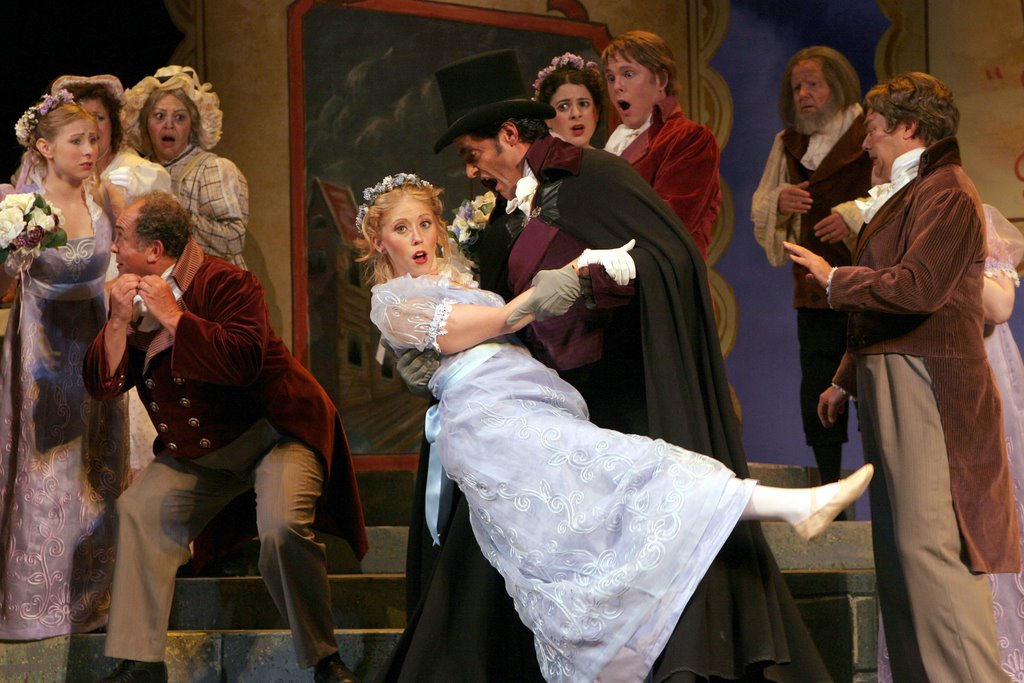
But the audience learns there's a much darker aspect to the saga during the number "Sir Rupert Murgatroyd," sung splendidly by Katy Daniel as Rose's guardian Dame Hannah, accompanied by the female chorus.
An endearing scene between Rose and Robin occurs after the two shyly encounter one another on a village street and awkwardly attempt to express the affection they feel toward each other during their sweet duet "I Know a Youth."
Things get complicated with the arrival of sailor Richard Dauntless (John Brown), who comes to town after years at sea. He quickly charms the professional bridesmaids-needed with so many couples coming to Rederring to be married-with the appealing number "From the Briny Sea." He also engages the bridesmaids in a mirthful dance and soon has them pulling from either end of a large rope in an impromptu game of tug of war.
Robin turns to the boisterous Richard to represent him in his bid for Rose's hand in marriage, never expecting that he would also fall in love with her. Richard overtly declares his affection for Rose with several kisses during the humorous and flirtatious number "The Battle's Roar is over." Now, Rose must decide between the introverted, wealthy gentleman who offers her an upper crust life or the fun, vivacious sailor with neither title nor money.
Robin adds intrigue to the plot by hiding his true identity. He's actually Sir Ruthven Murgatroyd, a long line of cursed baronets who must commit a daily crime or die an agonizing death. It all stems from a dead ancestor Sir Roderic Murgatroyd (played wonderfully by Behrend J. Eilers) who ordered a witch burned at the stake. Before she died she cursed him and his descendents. In an attempt to flee his fate, Robin forged his death and left his younger brother, Sir Despard Murgatroyd of Ruddygore (Charles Martin), to assume his role. Faithful servant Old Adam, played charmingly by William Neil, accompanies Robin into his new life.
Enter Mad Margaret, the former love of Sir Despard Murgatroyd and one of the most intriguing characters. Covered with mud, wearing ragged clothing and clearly insane, she's touchingly portrayed by Kathleen Moss who sings the poignant number "Cheerily Carols the Lark."
More mayhem ensues when the younger Murgatroyd appears in town searching for his brother. With his dark, good looks and the graceful swirl of his black cape, Martin gives a delicious performance as the villainous baronet, terrifying the bridesmaids during the number "Oh, Why am I Moody and Sad?"
What will become of them all? Only the unraveling of this melodramatic mystery will tell.
Judy Jackson Macllvaine beautiful costumes give "The Witch's Curse: Ruddygore" its rich, Victorian feel. Her elegant ensemble for Sir Despard Murgatroyd, with its rich cape and deep purple vest add to the foreboding persona of this character. Conversely, Rose Maybud's pink and white lace frock conveys her innocence. The lovely bridesmaids' dresses in lavender and pale blue with empire waists, sheer lace overlays and accompanying floral crowns also harken back to the era.
"The Witch's Curse: Ruddygore," plays Aug. 3-5 at the Hoffman Theatre, Dean Lesher Regional Center for the Arts, 1601 Civic Drive, Walnut Creek. For tickets call (925) 943-7469 or visit www.lamplighters.org.
Thursday, December 22, 2005
"The Hard Nut" offers hilarious twist on standard Christmas fare
For theatergoers wanting to enjoy a holiday production but who feel a bit weary of the traditional versions, there’s one rendition that gives a lively twists on standard Christmas fare.
Cal Peformances’ presentation of the Mark Morris Dance Group’s “The Hard Nut” offers a hilarious alternative to the classic tale of “The Nutcracker.” Based on the story “Nutcracker and Mouseking” by E.T.A. Hoffman and choreographed by Mark Morris, it’s a funky, chaotic version where appealing, engaging and sometimes creepy characters parade and dance across the stage to the delight and giggles of audience members.
Most of the action takes place in the Stahlbaum’s 1960s house complete with Adrianne Lobel’s cartoonish, black and white set and a gigantic white Christmas tree. Mrs. Stahlbaum’s a tall, well-coifed woman played hilariously by John Heginbotham. Dr. Stahlbaum’s played comically by Guillermo Resto. Both remain hip despite living in the suburbs. But they’re also at a loss as to how to handle their rambunctious three children, Marie (Lauren Grant), Fritz (June Omura) and Louise (Julie Worden).
At the Stahlbaum’s annual holiday do, guests range from an inebriated character (Mark Morris) from the 1970s with his full head of curly hair and wide lapels to the strange, eye-patched Drosselmeier (Craig Biesecker).
As a subplot, Drosselmeier’s search for a hard nut sends him off on a global journey where he encounters a variety of dancers from an Arabian seductress swathed in wonderful turquoise colored fabrics to Chinese maidens dressed in citrus colors of green and orange.
One of the funniest dance sequences in the productions features male and female ballet dancers portraying snowflakes. Dressed in midriff baring white tutus and donning shell shaped hats, they sprinkle snow around themselves on stage as members of the UC Women’s Chorale, directed by Mark Sumner, sing ethereal style music in the background. The Waltz of the Flowers also shows both genders of dancers in another humorous number. It also displays costume designer Martin Pakledinaz's exquisite talents with his vibrant, wispy petal costumes.
The Berkeley Symphony Orchestra with conductor Robert Cole at its helm performs Tchaikovsky’s “The Nutcracker” Op. 71 magnificently.
Mark Morris Dance Group’s “The Hard Nut” plays Dec. 9-18 at Zellerbach Hall, UC Berkeley, Bancroft Way in Berkeley. Tickets range from $32-$60. Call (510) 642-9988 or visit www.calperfs.berkelely.edu for more information.
For theatergoers wanting to enjoy a holiday production but who feel a bit weary of the traditional versions, there’s one rendition that gives a lively twists on standard Christmas fare.
Cal Peformances’ presentation of the Mark Morris Dance Group’s “The Hard Nut” offers a hilarious alternative to the classic tale of “The Nutcracker.” Based on the story “Nutcracker and Mouseking” by E.T.A. Hoffman and choreographed by Mark Morris, it’s a funky, chaotic version where appealing, engaging and sometimes creepy characters parade and dance across the stage to the delight and giggles of audience members.
Most of the action takes place in the Stahlbaum’s 1960s house complete with Adrianne Lobel’s cartoonish, black and white set and a gigantic white Christmas tree. Mrs. Stahlbaum’s a tall, well-coifed woman played hilariously by John Heginbotham. Dr. Stahlbaum’s played comically by Guillermo Resto. Both remain hip despite living in the suburbs. But they’re also at a loss as to how to handle their rambunctious three children, Marie (Lauren Grant), Fritz (June Omura) and Louise (Julie Worden).
At the Stahlbaum’s annual holiday do, guests range from an inebriated character (Mark Morris) from the 1970s with his full head of curly hair and wide lapels to the strange, eye-patched Drosselmeier (Craig Biesecker).
As a subplot, Drosselmeier’s search for a hard nut sends him off on a global journey where he encounters a variety of dancers from an Arabian seductress swathed in wonderful turquoise colored fabrics to Chinese maidens dressed in citrus colors of green and orange.
One of the funniest dance sequences in the productions features male and female ballet dancers portraying snowflakes. Dressed in midriff baring white tutus and donning shell shaped hats, they sprinkle snow around themselves on stage as members of the UC Women’s Chorale, directed by Mark Sumner, sing ethereal style music in the background. The Waltz of the Flowers also shows both genders of dancers in another humorous number. It also displays costume designer Martin Pakledinaz's exquisite talents with his vibrant, wispy petal costumes.
The Berkeley Symphony Orchestra with conductor Robert Cole at its helm performs Tchaikovsky’s “The Nutcracker” Op. 71 magnificently.
Mark Morris Dance Group’s “The Hard Nut” plays Dec. 9-18 at Zellerbach Hall, UC Berkeley, Bancroft Way in Berkeley. Tickets range from $32-$60. Call (510) 642-9988 or visit www.calperfs.berkelely.edu for more information.
Friday, February 4, 2005
Berkeley Rep’s "Fêtes de la Nuit" offers varying perspectives on amour
By Stephanie Wright Hession
Arts and Culture Writer
Just in time for Valentine’s Day Berkeley Rep presents Charles L. Mee’s “Fêtes de la Nuit,” a madcap kaleidoscope of viewpoints on amour-Parisian style. Directed by Les Waters, this production at the Roda Theatre offers naughty glimpses into romantic situations and everyday life inspired by Mee’s travels to Paris.
“Fêtes de la Nuit” starts out simple then gains momentum, thanks to music ranging from house style to Edith Piaf, impassioned dancing and a whirlwind of humorous vignettes including “Le Bistro,” “The Avant Garde,” and “Vin.” While not all interrelated, most contain some element of human sexuality such as desire. They also feature people of varying sexual orientations-straight, lesbian and gay. All the adventures occur amid Annie Smart’s minimalist set with its white stage, large draped curtain and simple rows of stairs.
“Le Bistro” evokes an authentic feel when a small gathering of men and women indulge in favorite Parisian pastimes: Smoking, drinking red wine and erupting into loud, impassioned debates-complete with arrogant, all knowing attitudes. Bruce McKenzie portrays Jean Francois-the brooding, chain-smoking, storyteller of the downtrodden-with brilliant wit.
“The Avant Garde” elicits giggles from the audience as a pianist, portrayed amusingly by Michi Barall, struggles to scoot her piano bench to just the right place. It’s all for naught because suddenly, she leaps on top of the piano and runs a string through its chords to produce bizarre sounds.
Joseph Kamal proves truly engaging as Barbesco. An intellectual, he gives an account of his various sexual dalliances that took place in the Jardin du Luxembourg as part of his speech at an academic conference.
“Fêtes de la Nuit” also features vibrant dancing. During a solo performance, dancer Jeffery Lynn McCann’s dexterity and athleticism mesmerizes as he makes a series of complex break dancing moves look effortless. And yet another, when 12 dancers-then 14-twist, turn and gyrate at a frenzied pace to highly charged music.
Costume designer Christal Weatherly’s highly imaginative creations, ranging from the impish to glamorous, provide the perfect accoutrements to this production. Especially during an outlandish fashion show with models proudly swaggering down a Paris runway. Standouts include Danny Scheie strutting about in a peacock blue suit accented with a flowing train of billowy, creme colored fabric. Maria Elena Ramirez epitomizes haute couture by donning a clingy black and white striped column dress and a hat adorned with large plums of white feathers. In keeping with the generally mischievous style of “Fêtes de la Nuit” there’s also a model wearing an 18th century white French wig with baskets of baguettes strapped to her hips.
This and many other scenes illustrate the playful charm of “Fêtes de la Nuit,” with Mee’s use of exaggeration as a means of conveying a sense of joir de vivre and a humorous way of looking at amour and daily life.
Two vignettes that don’t work and actually interrupt the chaotic rhythm of “Fêtes de la Nuit’s” are “Le Petomane” and “The Other Paris.” The first includes a tasteless bit centering around Le Petomane, portrayed by Bruce McKenzie, a 19th century performer who entertained crowds at the Moulin Rouge with his varied repertoire of flatulence. “The Other Paris” shows actual footage and news reports of rioting crowds in the outskirts of the city. It’s clearly meant as jarring but it feels totally out of place with the lighthearted feel of this play.
Overall however, “Fêtes de la Nuit” offers engaging tales as well as a breezy, cheeky approach sure to result in large amounts of laughter and plenty of eye candy.
“Fêtes de la Nuit” plays through Feb. 27 at Berkeley Rep’s Roda Theatre, 2015 Addison Street in Berkeley. Ticket prices range from $10 to $55 and can be purchased by calling 510-647-2949, toll free at 888-4-BRT-Tix or by visiting www.berkeleyrep.org.
Arts and Culture Writer
Just in time for Valentine’s Day Berkeley Rep presents Charles L. Mee’s “Fêtes de la Nuit,” a madcap kaleidoscope of viewpoints on amour-Parisian style. Directed by Les Waters, this production at the Roda Theatre offers naughty glimpses into romantic situations and everyday life inspired by Mee’s travels to Paris.
“Fêtes de la Nuit” starts out simple then gains momentum, thanks to music ranging from house style to Edith Piaf, impassioned dancing and a whirlwind of humorous vignettes including “Le Bistro,” “The Avant Garde,” and “Vin.” While not all interrelated, most contain some element of human sexuality such as desire. They also feature people of varying sexual orientations-straight, lesbian and gay. All the adventures occur amid Annie Smart’s minimalist set with its white stage, large draped curtain and simple rows of stairs.
“Le Bistro” evokes an authentic feel when a small gathering of men and women indulge in favorite Parisian pastimes: Smoking, drinking red wine and erupting into loud, impassioned debates-complete with arrogant, all knowing attitudes. Bruce McKenzie portrays Jean Francois-the brooding, chain-smoking, storyteller of the downtrodden-with brilliant wit.
“The Avant Garde” elicits giggles from the audience as a pianist, portrayed amusingly by Michi Barall, struggles to scoot her piano bench to just the right place. It’s all for naught because suddenly, she leaps on top of the piano and runs a string through its chords to produce bizarre sounds.
Joseph Kamal proves truly engaging as Barbesco. An intellectual, he gives an account of his various sexual dalliances that took place in the Jardin du Luxembourg as part of his speech at an academic conference.
“Fêtes de la Nuit” also features vibrant dancing. During a solo performance, dancer Jeffery Lynn McCann’s dexterity and athleticism mesmerizes as he makes a series of complex break dancing moves look effortless. And yet another, when 12 dancers-then 14-twist, turn and gyrate at a frenzied pace to highly charged music.
Costume designer Christal Weatherly’s highly imaginative creations, ranging from the impish to glamorous, provide the perfect accoutrements to this production. Especially during an outlandish fashion show with models proudly swaggering down a Paris runway. Standouts include Danny Scheie strutting about in a peacock blue suit accented with a flowing train of billowy, creme colored fabric. Maria Elena Ramirez epitomizes haute couture by donning a clingy black and white striped column dress and a hat adorned with large plums of white feathers. In keeping with the generally mischievous style of “Fêtes de la Nuit” there’s also a model wearing an 18th century white French wig with baskets of baguettes strapped to her hips.
This and many other scenes illustrate the playful charm of “Fêtes de la Nuit,” with Mee’s use of exaggeration as a means of conveying a sense of joir de vivre and a humorous way of looking at amour and daily life.
Two vignettes that don’t work and actually interrupt the chaotic rhythm of “Fêtes de la Nuit’s” are “Le Petomane” and “The Other Paris.” The first includes a tasteless bit centering around Le Petomane, portrayed by Bruce McKenzie, a 19th century performer who entertained crowds at the Moulin Rouge with his varied repertoire of flatulence. “The Other Paris” shows actual footage and news reports of rioting crowds in the outskirts of the city. It’s clearly meant as jarring but it feels totally out of place with the lighthearted feel of this play.
Overall however, “Fêtes de la Nuit” offers engaging tales as well as a breezy, cheeky approach sure to result in large amounts of laughter and plenty of eye candy.
“Fêtes de la Nuit” plays through Feb. 27 at Berkeley Rep’s Roda Theatre, 2015 Addison Street in Berkeley. Ticket prices range from $10 to $55 and can be purchased by calling 510-647-2949, toll free at 888-4-BRT-Tix or by visiting www.berkeleyrep.org.


Saturday, January 29, 2005
"ACT’s 'The Gamester' offers a rollicking good time."
By Stephanie Wright Hession
Arts and Culture Writer
For those looking to indulge in a riotous romp there's “The Gamester,” American Conservatory Theater’s current production at the Geary Theater. Based upon Jean-Francois Regnard’s “Le Joueur” and set in late 17th century Paris, this adaptation by playwright Freyda Thomas centers on Valère (played by Lorenzo Pisoni) a likeable cad who’s obsessed with gambling.
It’s overshadowed his life so much that debtors rap emphatically on his front door and his father Thomas (played by Steve Irish) disowned him. That’s disheartening enough but now his fiancé, the beautiful, naïve and very wealthy Angélique (played sweetly by Margot White), gives Valère an ultimatum: The game or her. Adding to the pressure, Valère’s crusty old Uncle Dorante (played hilariously by Ron Campbell) schemes to make Angélique his new bride. What’s a gambler to do?
 .
.
With his dark-haired good looks and athletic build, Lorenzo Pisoni portrays Valère with vulnerability, charisma and agility as he tumbles and fights his way to a decision. A host of mirthful characters cross Valère’s path-each with their own agenda-and thoroughly entertain the audience, thanks to a plethora of high jinks, pranks and mischief.
Among them, Madame Sécurité (played saucily by Joan Mankin), a glamorous, affluent widow with an insatiable appetite for amour who satisfies it by lingering around casinos. Then when male gamblers find themselves broke but not yet ready to quit, she swoops down to offer them francs in exchange for a quick tête-à-tête. Those indebted to her include Valère who she stops by to visit at his shabby quarters. There, her dominatrix style seduction proves clever and swift. With a quick turn she removes Valère’s belt. Then she slyly pulls out a whip tucked away in her décolletage. With Valère staring at her helplessly while seated on a stool, Madame Sécurité strips off his shirt and coils the whip around his neck. Before he realizes it, he’s flayed on the floor with her on top. Following a chase scene they end up in his weathered bed where Valère quips, “They all look the same in the dark.”
 .
.
Anthony Fusco delivers an engaging and delightful performance as Marquis de Fauxpas, a fancy dresser and an elegant speaker. That is, unless he’s around Madame Argante, Angélique’s widowed, cynical elder sister played charmingly by René Augesen. Secretly, the Marquis fancies her so in her presence he stutters and can barely speak. Stacy Ross portrays Madame Préférée, Angélique’s cunning, manipulative servant, with clever wit as her character exploits people and circumstances for her own plans and schemes.
Beaver Bauer’s elegant costumes beautifully convey the opulence of 17th century Baroque France, with the use of rich fabrics and wonderful detail. As actors take the stage in each creation it’s difficult to rate one more gorgeous than the next. However, Madame Sécurité’s red brocade gown accented with gold, with its sheer, resplendent cape topped with plumes of crimson feathers, proves exquisite. In another scene, Marquis de Fauxpas’ textured gold suit featuring rings of bright yellow feathers-topped with a petite hat with pheasant feathers-illustrates his flamboyant persona.
Kate Edmund’s uncomplicated, modern set with its ceiling-high playing cards-depicting the Queen of Hearts no less-provides the perfect backdrop. Director Ron Lagomarsino brings Thomas’ script to life with a frenetically paced and fun production. However, Thomas’ rhyming lyrics grow tedious despite the vigorous comic delivery by a superb cast. While this production showcases wonderful performances and stunning costumes, the script disappoints due to its lack of substance.
“The Gamester,” plays through February 6. American Conservatory Theater, 415 Geary St., San Francisco. Tickets $15-$68. Call 415-749-2228 or visit www.act-sf.org.
Arts and Culture Writer
For those looking to indulge in a riotous romp there's “The Gamester,” American Conservatory Theater’s current production at the Geary Theater. Based upon Jean-Francois Regnard’s “Le Joueur” and set in late 17th century Paris, this adaptation by playwright Freyda Thomas centers on Valère (played by Lorenzo Pisoni) a likeable cad who’s obsessed with gambling.
It’s overshadowed his life so much that debtors rap emphatically on his front door and his father Thomas (played by Steve Irish) disowned him. That’s disheartening enough but now his fiancé, the beautiful, naïve and very wealthy Angélique (played sweetly by Margot White), gives Valère an ultimatum: The game or her. Adding to the pressure, Valère’s crusty old Uncle Dorante (played hilariously by Ron Campbell) schemes to make Angélique his new bride. What’s a gambler to do?
. With his dark-haired good looks and athletic build, Lorenzo Pisoni portrays Valère with vulnerability, charisma and agility as he tumbles and fights his way to a decision. A host of mirthful characters cross Valère’s path-each with their own agenda-and thoroughly entertain the audience, thanks to a plethora of high jinks, pranks and mischief.
Among them, Madame Sécurité (played saucily by Joan Mankin), a glamorous, affluent widow with an insatiable appetite for amour who satisfies it by lingering around casinos. Then when male gamblers find themselves broke but not yet ready to quit, she swoops down to offer them francs in exchange for a quick tête-à-tête. Those indebted to her include Valère who she stops by to visit at his shabby quarters. There, her dominatrix style seduction proves clever and swift. With a quick turn she removes Valère’s belt. Then she slyly pulls out a whip tucked away in her décolletage. With Valère staring at her helplessly while seated on a stool, Madame Sécurité strips off his shirt and coils the whip around his neck. Before he realizes it, he’s flayed on the floor with her on top. Following a chase scene they end up in his weathered bed where Valère quips, “They all look the same in the dark.”
. Anthony Fusco delivers an engaging and delightful performance as Marquis de Fauxpas, a fancy dresser and an elegant speaker. That is, unless he’s around Madame Argante, Angélique’s widowed, cynical elder sister played charmingly by René Augesen. Secretly, the Marquis fancies her so in her presence he stutters and can barely speak. Stacy Ross portrays Madame Préférée, Angélique’s cunning, manipulative servant, with clever wit as her character exploits people and circumstances for her own plans and schemes.
Beaver Bauer’s elegant costumes beautifully convey the opulence of 17th century Baroque France, with the use of rich fabrics and wonderful detail. As actors take the stage in each creation it’s difficult to rate one more gorgeous than the next. However, Madame Sécurité’s red brocade gown accented with gold, with its sheer, resplendent cape topped with plumes of crimson feathers, proves exquisite. In another scene, Marquis de Fauxpas’ textured gold suit featuring rings of bright yellow feathers-topped with a petite hat with pheasant feathers-illustrates his flamboyant persona.
Kate Edmund’s uncomplicated, modern set with its ceiling-high playing cards-depicting the Queen of Hearts no less-provides the perfect backdrop. Director Ron Lagomarsino brings Thomas’ script to life with a frenetically paced and fun production. However, Thomas’ rhyming lyrics grow tedious despite the vigorous comic delivery by a superb cast. While this production showcases wonderful performances and stunning costumes, the script disappoints due to its lack of substance.
“The Gamester,” plays through February 6. American Conservatory Theater, 415 Geary St., San Francisco. Tickets $15-$68. Call 415-749-2228 or visit www.act-sf.org.
Subscribe to:
Posts (Atom)